You know that moment when you open a dating app and it feels like you just stepped on stage. Pick the “right” photos. Write a bio that’s funny but not cringe. Pretend you’re chill about it. Then you realize your coworker, your cousin’s friend, and that guy from your gym might all see it. Hard pass.
That’s why the idea of a dating app without profiles is having a moment. No public page. No highlight reel. No “sell yourself in 150 characters.” Just a quieter way to figure out if interest is mutual – without turning your love life into content.
But “no profiles” can mean a few different things, and the details matter. Some apps remove the profile page but still push you into swiping on strangers. Others are built for people who already have someone in mind and just need a low-drama way to send a signal.
What “dating app without profiles” actually means
Most traditional dating apps run on the same engine: public-ish profiles plus discovery. You create a page, the app distributes you, and you sort through other people doing the same. Even if it’s “private,” it’s still a marketplace.
A dating app without profiles flips that. Instead of broadcasting who you are to get matches, the app reduces or removes the public identity layer. The goal isn’t to perform. It’s to communicate.
There are three common versions:
First, minimal profiles. You technically have one, but it’s barebones and not designed for browsing. This cuts down on the “personal brand” pressure, but you may still be shown to lots of people.
Second, hidden profiles. You might set info for the app’s internal use, but other users don’t see a searchable page. This reduces random exposure, but the app can still run discovery behind the scenes.
Third, no discovery at all. No swiping, no “people near you,” no random DMs. You’re not being distributed to strangers, period. Instead, you choose a specific person (often someone you already know) and send a private signal.
If you’re here because you want less chaos and more control, that third version is usually what you mean – even if you haven’t had the words for it.
Why people want to ditch profiles (and it’s not just privacy)
Privacy is the headline, but it’s not the whole story.
Profiles create social risk. If you live in a shared environment – campus, your neighborhood, your workplace, your friend group – being “out there” changes how you’re perceived. Some people are fine with that. A lot of people are not.
Profiles also create crush paralysis. You can be genuinely into someone you already know, but you end up doom-scrolling strangers because it feels safer than taking a real shot. Swiping becomes a distraction from the one person you actually care about.
Then there’s rejection math. Getting rejected by a stranger stings, but it fades fast. Getting rejected by someone in your daily life can echo for months. You see them in the hallway. You share a group chat. You’re stuck replaying the moment.
A profile-free setup appeals because it’s private by default and it puts your attention where your life already is: the people you actually interact with.
How a profile-free dating app usually works
When there’s no profile page to browse, the app has to provide a different path to connection.
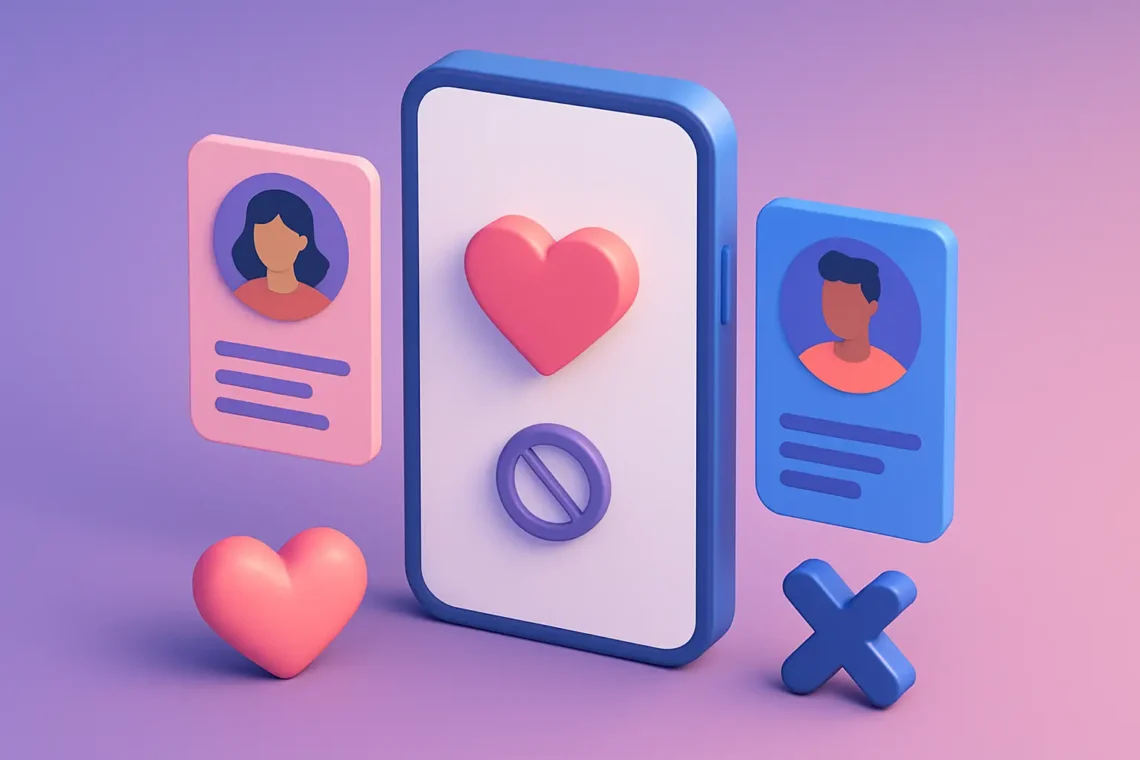
In the best versions, it’s simple: you pick a person, send a signal, and the app only reveals identities when interest is mutual. That’s the key design choice. Mutual-only reveals remove the “what if they tell everyone?” fear because there’s nothing to expose unless both people said yes.
This setup tends to come with a few hard rules:
You don’t get randoms. That’s intentional. The app is not a casino.
You don’t get public search visibility. If someone can scroll a directory and find you, that’s basically a profile economy again.
You don’t get endless in-app chatting. The point is to confirm the vibe and then move it offline. When the app becomes the relationship, it turns into a pen-pal situation.
This approach is closer to “signal and confirm” than “market and match.” It’s dating, but with guardrails.
The trade-offs: what you give up when you give up profiles
No profiles sounds like a cheat code, but it comes with real trade-offs. Whether they matter depends on your situation.
You give up easy context. A profile can answer basic questions quickly: age, intent, lifestyle, maybe politics or religion. Without that, you’re leaning on real life context (how you know them, what you’ve observed) or you’re asking directly.
You give up discovery. If you’re brand new in town, work remotely, or your social circle is tiny, a warm-network model can feel limiting. Swiping apps are messy, but they do introduce you to people you’d never meet otherwise.
You give up a layer of filtering. Profiles let you pre-screen for dealbreakers. In a profile-free system, you might confirm mutual interest first, then realize you’re misaligned. That’s not a disaster, but it’s different.
The upside is you also give up a lot of the nonsense: the performance, the public exposure, the “why is this person watching my stories but not replying” energy.
Who a dating app without profiles is perfect for
If you’ve got one specific person in mind right now, you’re the target user. The classmate you keep making eye contact with. The friend-of-a-friend who always lingers after the hangout. The coworker you can’t read because professionalism makes everything weird.
It’s also ideal if you’re in a reputation-sensitive environment. Teens, college students, and young professionals live inside social ecosystems where gossip travels faster than facts. A profile-free model keeps things quieter.
And yes, it works for older adults too, especially people re-entering dating after divorce who hate the swipe circus. If you want something grounded and you already meet people through real life – your community, your kids’ schools, work, friends – profiles can feel like cosplay.
In all these cases, the value isn’t “more options.” It’s less anxiety.
Who should probably stick with profiles (for now)
If you don’t know anyone you’d date and you’re truly starting from zero, profiles can be useful. They’re a billboard, and sometimes you need a billboard.
If you’re exploring identity, preferences, or what you even want, browsing profiles can help you learn. It’s not always healthy, but it can be informative.
And if your biggest problem is that you never meet new people offline, a warm-network app won’t fix that by itself. You may need to build social inputs first: new classes, new routines, new communities.
A dating app without profiles isn’t “better.” It’s a better fit for a specific kind of dating reality: you already have proximity, you just need permission.
The safety piece: what to look for beyond “no profiles”
“No profiles” is a start, not a guarantee. Some apps claim to be private but still leak social risk through other mechanics.
Look for mutual-only identity reveals. If someone can see you sent interest before they reciprocate, that’s not crush anxiety solved – that’s crush anxiety with receipts.
Look for encrypted messaging and private-by-default accounts. If the app treats your activity like content, it will eventually behave like a social platform.
Look for no photo or video sharing inside the app if discretion is the point. Images are where privacy goes to die, especially when screenshots exist.
And look for an intentional off-ramp. A good app doesn’t trap you in endless chat. It nudges you toward a real plan: “Cool, you both said yes. Now go get coffee.”
A real-world example: warm-network “crush” mechanics
One clean model is what wadaCrush is built around: you send discreet, encrypted crush messages to someone you already know, identities stay masked until you pair, and there’s no swiping, no randoms, and no public profiles. The whole vibe is “shoot your shot with 0% awkwardness,” then get out of the app and back into real life.
That design choice matters because it doesn’t just remove profiles – it removes the discovery machine that makes profiles feel required in the first place.
How to use a profile-free app without making it weird
The main fear people have is: “Okay, but what do I say after we match?” Good news: you don’t need a screenplay.
Keep it simple and human. The power move is clarity.
If you already know each other, reference your shared context. “Okay hi, I was hoping it was you. Want to grab coffee after class?” lands better than a generic pickup line because it matches real life.
Don’t over-chat. The whole point is to confirm mutual interest, then move to a low-stakes hangout. If you drag it out for a week, you recreate the same anxious loop you were trying to escape.
And if it’s not a fit after you match, be kind and brief. A profile-free system reduces public embarrassment, but you still owe basic respect. “You’re great, I’m not feeling the vibe romantically” is enough.
The bigger shift: from performance to permission
Profiles trained us to treat dating like marketing. Better photos equal better outcomes. Better copy equals better outcomes. And if you’re not winning, you must need to optimize.
A dating app without profiles pushes back on that. It’s not asking you to be more “interesting.” It’s giving you a safer way to ask a specific person a specific question: is this mutual?
And honestly, that’s the only question that matters.
Closing thought: if your dating life feels loud, try a quieter move. The right connection usually doesn’t need an audience – it needs a clear signal and the courage to follow it into real life.