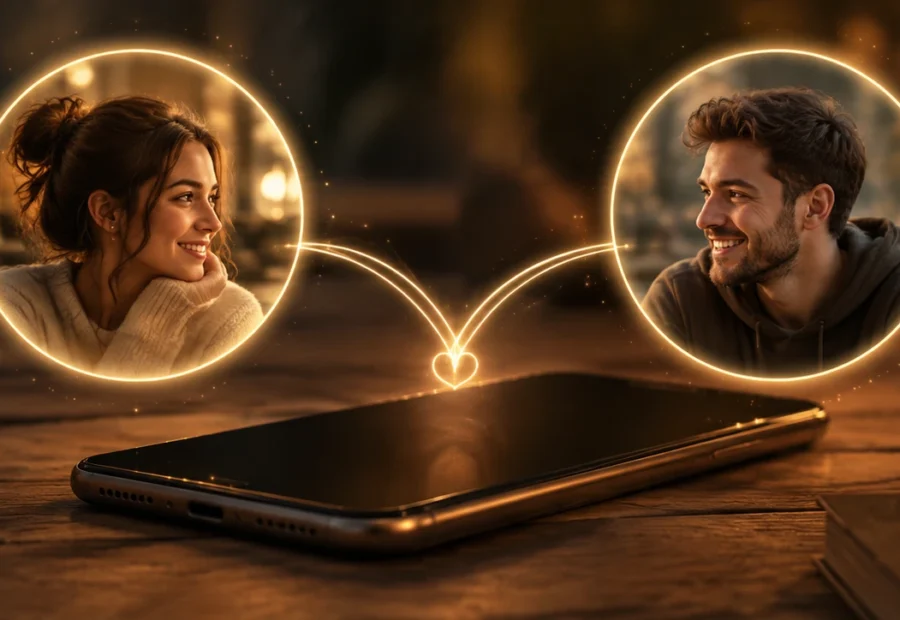

The person you are thinking about may not be a stranger in a profile stack. They may already be in your contacts.
That is the case a no swipe dating app is built to address. Instead of asking, “Who new can I discover?” the starting question becomes, “Does this person I already know feel the same?” Those are different jobs, and they call for different product design.
Table of Contents
Table of Contents
For people interested in dating without swiping, privacy matters in a very practical way. You may share a class, workplace, friend group, gym, or community with the person. A one-sided move can feel bigger because neither of you disappears from the other’s life when the app closes.
This guide looks at seven checks that separate a thoughtful real life dating app from a normal discovery product with a different label.
What a no-swipe dating app for real life connections actually is
A no swipe dating app for real life connections is exactly what it sounds like: no endless profile deck, no randoms, no public browsing. Instead of matching with strangers, you express interest in someone you already know in real life.

That could be a friend, coworker, classmate, mutual, neighbor, or someone you keep crossing paths with but never quite know how to approach.
The smart version of this model is mutual-only. You send a private signal, and your identity stays hidden unless the other person feels the same. No public profile theater. No “seen” humiliation. No weird social fallout from being too direct too soon.
That’s why apps like wadaCrush stand out. They aren’t trying to replace real chemistry with feed mechanics. They’re built to reduce the emotional risk around real-life attraction, especially when the stakes feel higher because you already know the person.
Why swiping strangers stops working for a lot of people
Swipe apps can be fun for a minute. They’re fast, low-commitment, and easy to use when you want options.
But they also create a very specific kind of dating fatigue. You end up sorting faces instead of feeling connection. Conversations start cold. Intent is fuzzy. And if what you really want is someone already in your world, swiping can feel like shopping for an alternative instead of acting on what’s real.
That doesn’t mean swipe apps are bad. They’re just optimized for discovery, not discretion.
A real-life dating app without swiping flips the priority. It assumes attraction often starts before the app ever enters the picture. The app’s job is not to manufacture chemistry. It’s to help you confirm whether the vibe is mutual.
That difference matters a lot if you care about privacy, emotional safety, and not making your social circle weird.
How mutual-only real-life dating apps work
1. You choose a real person, not a random profile
Instead of browsing strangers, you send interest toward someone you actually know. Usually that happens through a phone number or email, not by searching a public profile catalog.
2. Your identity stays masked at first
This is the make-or-break feature. If the app reveals your name immediately, it defeats the point.
The better setup keeps things discreet until the other person also signals interest. That creates less awkwardness on the one-sided side of the equation. If it’s not mutual, there’s no public rejection scene to replay in your head at 2 a.m.
3. A match only happens when both people opt in
Mutual pairing is the whole safety net. No one gets exposed for having feelings unless both people are on the same page.
Some apps also let the other person receive the invite even if they weren’t already on the platform, which matters more than it sounds. Real-life attraction doesn’t wait for perfect app overlap.
For a privacy-first example, wadaCrush keeps profiles private by default, masks identities until you pair, and can notify someone through their phone number or email even if they haven’t joined yet. That setup is pretty rare, and honestly, it is a distinct structure from a conventional discovery app if your goal is known-person dating without public risk.
Who this works best for
This kind of app is not for everyone, and that’s actually a good sign.
It works best for people who already have someone in mind. If you secretly like your friend, your classmate, your coworker, or someone in your wider social circle, a no-swipe dating app for real life connections gives you a private way to test the waters.
It also makes sense if you’re over swipe culture in general. Maybe you don’t want random attention. Maybe you value privacy more than volume. Maybe you’d rather explore one meaningful possibility than collect weak matches with strangers three cities away.
It works less well if you want constant novelty or broad discovery. If your main goal is meeting lots of new people fast, traditional dating apps still do that job better.
So yes, it depends on your dating style. If your love life usually starts with real-life familiarity, this model fits better.
The trade-offs to know before you try one
A no-swipe dating app for real life connections solves a lot, but it doesn’t solve everything.
First, it’s more intentional. That sounds nice, but it also means you need an actual person in mind. You can’t hide behind passive scrolling and hope destiny sorts it out.
Second, privacy-first apps tend to have tighter guardrails. That’s the point, but it can feel restrictive if you’re used to open browsing. No public profile feed means less entertainment value and more focus.
Third, mutual-only systems protect you from cringe, but they also limit one-sided pursuit. Again, that’s a feature, not a bug. Still, if someone wants an app that lets them chase people who haven’t shown interest, this isn’t that.
For most people, those are healthy trade-offs. Less chaos, less exposure, more clarity.
A practical example of how to use it without making things weird
Let’s say you like someone from your grad program. You’ve talked a few times. The vibe feels good, but not clear enough to risk a direct confession in the hallway before class.
A no-swipe dating app for real life connections lets you send a quiet signal first.
If they feel the same, great – now there’s a reason to talk without pretending it came out of nowhere.
If they don’t, nothing gets blown up socially.
And if you do match and want to start the conversation without overcooking it, keep it simple:
If they say: “Hey, so this is kind of funny.” You can reply: “Honestly, I’m glad the vibe-check was mutual. Want to grab coffee after class this week?”
That works because it’s calm. No big performance. No pressure spiral.
What to look for in the best app
If you’re comparing options, this is the snippet-level checklist that actually matters:
- No swiping or public browsing
- Private by default profiles
- Masked identities until mutual interest
- Ability to connect with someone not already on the app
- Clear limits that prevent random discovery and unwanted exposure
That’s the difference between a true mutual-interest tool and a normal dating app wearing a privacy costume.
If you want more context on intentional dating, emotional safety, and modern crush culture, the wadaCrush blog has room for that broader conversation too, especially if you’re sorting out whether to act on a real-life connection or leave it alone.
FAQ
Is a no-swipe dating app better than Tinder or Bumble?
Better for some people, yes. If you want to meet strangers, probably not. If you want to discreetly express interest in someone you already know, absolutely.
Can this work for coworkers or classmates?
Yes, but context matters. A mutual-only setup is much safer than a direct advance because it lowers pressure and avoids public awkwardness. Still, use common sense around workplace policies and power dynamics.
What if the other person isn’t on the app yet?
Some platforms can still notify them through phone number or email and let them join the mutual flow from there. That’s a big advantage for real-life dating because timing is rarely perfect.
Is it actually anonymous?
The good ones are discreet, not chaotic-anonymous. Your identity is hidden until both people express interest, which is very different from random anonymous messaging.
Are no-swipe apps only for serious relationships?
Not necessarily. They’re more about intentionality than labels. Some people use them for dating with relationship potential, others just want a clean way to shoot their shot.
Real attraction is already messy enough. Your app doesn’t need to add extra drama. If someone is already on your mind, a private, mutual-only path makes a lot more sense than performing for strangers and hoping the right person appears.
Dating without swiping starts with intent, not inventory
Swipe-based dating is fundamentally a discovery model. You are shown people you may not know and decide whether you want to connect. That can be useful when your goal is to expand the pool.
Dating without swiping is more intentional when you already have a person in mind. The app does not need to manufacture attraction or keep you browsing. It needs to help two people handle uncertainty without creating unnecessary exposure.
That difference sounds small, but it changes almost every design choice: whether profiles are public, whether strangers can search you, whether both people must already have accounts, and when identity becomes visible.
Real life dating app check #1: does it start with someone you know?
A real life dating app should be honest about its starting point. If the experience quickly becomes a feed of unfamiliar profiles, it is still a discovery app, even if the marketing talks about authenticity.
wadaCrush’s How It Works page explicitly starts with someone already in your real life and says there is no stranger-swiping flow. That makes it easier to evaluate the product against the problem it says it solves.
No swipe dating app check #2: what is visible before mutual interest?
A no swipe dating app should explain what the recipient sees before a match. The privacy question is not simply “is it anonymous?” Permanent anonymity can create its own problems. The more useful model is temporary privacy: interest is protected until it is mutual, then both people know who they are talking to.
Look for a clear answer about name, photo, profile details, contact information, and whether people can browse or search for you. “Private” should describe actual behavior, not just a slogan.
Check #3: can someone receive a signal without already being a user?
This matters more in known-person dating than it does in discovery apps. Your crush may never have downloaded the same dating product you did.
wadaCrush says a recipient can receive a discreet notification even if they are not already registered. That closes a common gap in dating without swiping: the connection exists in real life before app overlap exists.
Check #4: what happens when the interest is not mutual?
The best answer is usually very little. No public rejection. No reveal of the sender just because the recipient is curious. No repeated anonymous pursuit.
Mutual-only systems are most useful when a non-match ends quietly. If a product keeps pushing the recipient to engage or gives the sender new ways to press for an answer, the privacy feature has stopped serving both people.
Check #5: does it reduce exposure without pretending risk disappears?
No dating product can promise zero awkwardness or zero rejection. Real people still have feelings, shared histories, and different expectations.
Pew Research Center’s 2023 survey of U. S. online dating found mixed experiences: many users reported positive outcomes, while safety and harassment were also meaningful concerns. The lesson is not that one app model is universally better. It is that the interaction design matters.
Check #6: does the app know when its job is finished?
A privacy-first signal is useful for the uncertain first step. Once both people have chosen each other, the healthiest next move is usually ordinary communication.
A real life dating app should not make the couple keep performing their relationship inside the product just to justify engagement metrics. The app can open the door; the people decide what happens next.
Check #7: does the model fit your actual dating goal?
If you want to meet many new people, a no-swipe approach may feel unnecessarily narrow. Discovery apps are designed for exactly that use case.
If you are already thinking about one person, the calculation changes. A no swipe dating app can make more sense because the valuable feature is not more choice—it is a quieter way to test one real possibility.
For a deeper look at this design philosophy, read why mutual matching works differently. If the person is part of your existing group, the guide to dating within social circles covers the human side of the decision.
That restraint is exactly what can make a real life dating app useful for a sensitive situation.
Good privacy is often unexciting. There is no mystery reveal for entertainment, no public ranking of who likes whom, and no reason to keep someone browsing when the person they care about is already known.
The privacy mechanics of a no swipe dating app should be easy to explain. Who can find you? What is sent? What is hidden? What action reveals identity? What ends the interaction? If the answers require a maze of exceptions, the user is carrying risk the product should have designed away.
A no-swipe app should be boring in the right places
If you find yourself using no swipe dating app to avoid every direct conversation, the tool has probably done all it can. Once interest is mutual, clarity matters more than another layer of signaling.
The best use of no swipe dating app is a clear, voluntary interaction that leaves both people with room to choose. The same standard applies to dating without swiping and real life dating app: privacy should reduce unnecessary exposure without creating pressure.
No Swipe Dating App: the final standard
That quiet exit is not a missing feature. It is part of the value proposition when the two people may still see each other in real life.
A privacy-first product should be just as clear about what happens when interest is not returned as it is about the happy path. If nothing is mutual, there should be no public reveal, no pressure to explain, and no escalating sequence designed to force a response.
One more no swipe dating app check: can you explain the exit?
Keep reading
If this topic is close to your situation, continue with mutual matching guide or dating within social circles.
Compare the matching model
What matters here is the pattern you can actually observe. When evaluating no swipe dating app, look past the marketing screen and check the actual defaults. dating without swiping should reduce unnecessary exposure, while real life dating app should make it clear what happens before, during, and after a match.
The point is not to eliminate uncertainty; it is to remove avoidable confusion and make the next step proportionate to what you actually know.
What happens after mutual interest
The practical version is less dramatic than people expect. A useful way to judge no swipe dating app is to follow the whole user journey. Ask what another person can see, what gets stored, and how dating without swiping and real life dating app affect a non-match as well as a successful one.
The point is not to eliminate uncertainty; it is to remove avoidable confusion and make the next step proportionate to what you actually know.
Account recovery deserves attention
A useful way to think about this is to make the next decision smaller. For no swipe dating app, privacy and product fit belong in the same conversation. Strong dating without swiping gives users control; sensible real life dating app keeps that control understandable in real situations.
The point is not to eliminate uncertainty; it is to remove avoidable confusion and make the next step proportionate to what you actually know.