
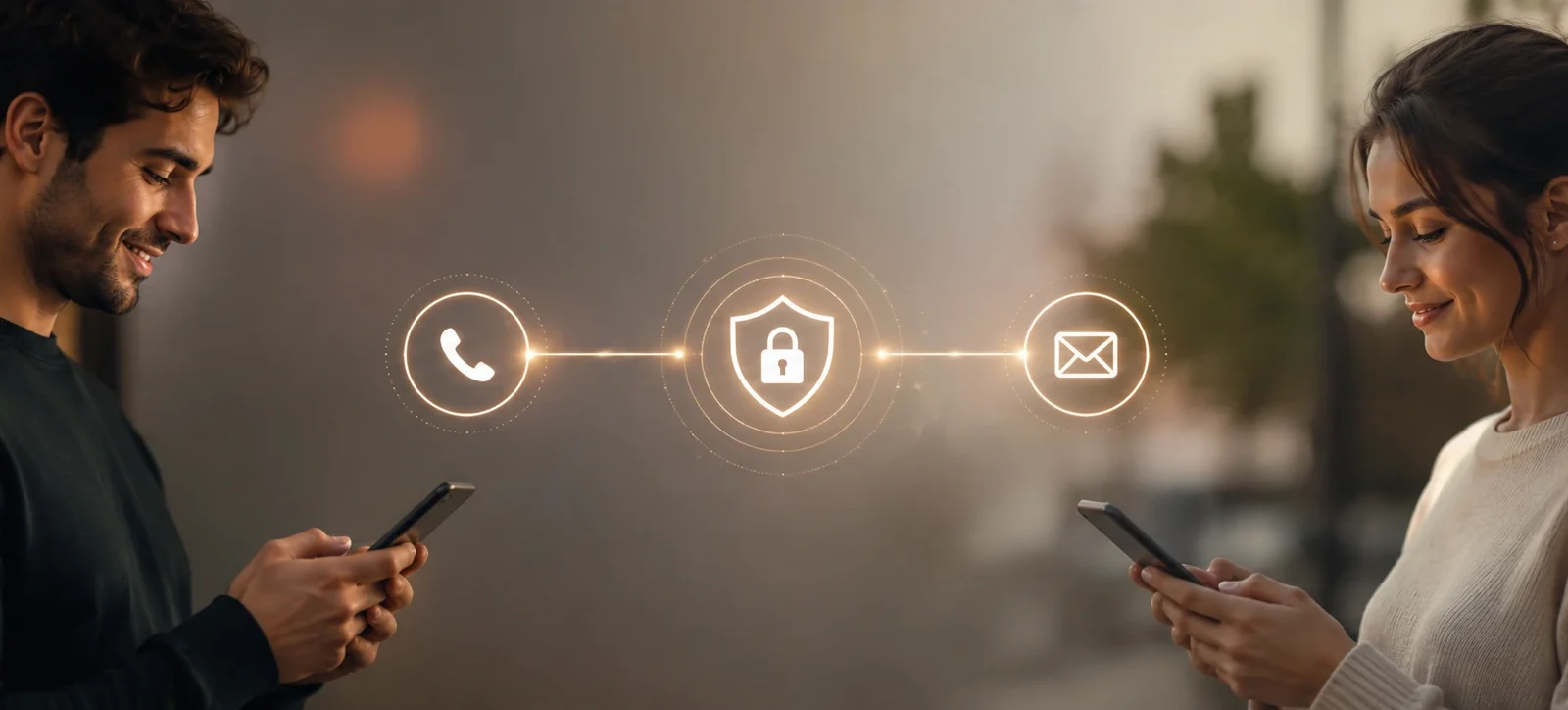
The interesting part of contact matching is not the contact itself. It is what the system does—and does not reveal—when you use it.
Contact based matchmaking starts with someone already in your world and an identifier you legitimately know, such as a phone number or email address. That makes it different from browsing strangers, but it does not automatically make it private.
Table of Contents
Table of Contents
Good phone number matchmaking and email matchmaking should treat the identifier as a routing mechanism, not as a searchable dating directory. The recipient needs control, the sender needs clear limits, and a non-match should not trigger more exposure.
These seven checks are a practical way to evaluate whether a contact-based system respects that boundary.
What contact based matchmaking actually means
Contact based matchmaking is a way to express romantic interest using a direct identifier – usually a phone number or email address – rather than searching public profiles or swiping through strangers.

That makes it a very different setup from traditional dating apps. There is no endless feed, no random discovery, and ideally no public profile browsing. Instead, the system is built around a known person. You already have some connection, even if it is light. The app or service simply creates a safer lane for mutual-interest discovery.
If you have ever thought, I would absolutely shoot my shot if there were a less awkwardness option, this is the category you are looking at.
Why people use it instead of traditional dating apps
Most dating products are designed for stranger discovery. That works fine if you want volume, novelty, or a wider pool. But it is not great when your actual romantic tension lives inside your real life.
A friend group, a college class, a workplace, a hobby circle, a neighborhood, a wedding crew – these are not spaces where people want public rejection or screenshots floating around. Contact based matchmaking exists because social risk is real. People hold back not because they do not care, but because the cost of being wrong can feel too high.
That is where a privacy-first app like wadaCrush makes sense. It is built for known-person mutual intent, not randoms, with identities masked until both people are interested. It can even notify someone who is not on the app yet through their phone number or email, which is kind of the whole cheat code here.
How contact based matchmaking works
At a high level, the flow is simple. You enter a contact point tied to the person you like, such as their phone number or email. The platform sends a private signal of interest. If the other person also opts in or sends interest back, the match is revealed. If not, your identity stays hidden.
Here is the basic loop:
- You choose a known person using a verified contact method.
- The system records your interest privately.
- The other person gets a discreet prompt or invitation.
- Only a mutual response reveals the match.
That mutual-only layer matters more than people think. It is the difference between a private vibe-check and a one-sided anonymous message that just makes someone uncomfortable.
What makes this different from anonymous confession tools
Not every anonymous crush tool is doing the same job. Some are basically confession boxes. They create suspense, but not necessarily safety.
A true contact based matchmaking system should be designed around consent, privacy, and mutual reveal. That means no open public profiles, no searchable catalog of people, and no pressure for the recipient to engage. If the setup feels like it could be used to corner someone, it is not a smart setup.
When contact based matchmaking works best
This model works best when the connection already exists but the timing is fuzzy.
It fits well for classmates, friends of friends, coworkers with appropriate boundaries, casual acquaintances, and people from shared communities. It is especially useful when direct flirting could create tension if the feeling is not mutual.
It works less well if you barely know the person, only saw them once, or are trying to use it as a shortcut around basic social awareness. Contact based matchmaking is not meant to replace respect, context, or judgment. It is meant to reduce unnecessary cringe when there is already a real-world connection.
The workplace question
This is the biggest it-depends area.
If your workplace has clear policies against coworker dating, or if there is any power imbalance, do not force it. Privacy tools are not a loophole for ignoring professional boundaries. But in peer situations where dating is allowed and both people know each other socially, a mutual-only system can be less awkward than a direct ask in the office kitchen.
The privacy trade-offs to check before using it
A good guide to contact based matchmaking has to talk about the catch: using contact information is sensitive by default.
So before you use any platform in this category, check the guardrails. Does it keep profiles private by default? Does it reveal identities only on a mutual match? Can people browse or search others publicly? Are contact methods verified? Is there a limit to spammy behavior? Those details decide whether the product feels protective or intrusive.
The best products in this space are not trying to maximize attention. They are trying to minimize social damage.
That is also why this model appeals to people who are tired of swipe culture. It is lower-volume, more intentional, and way more grounded in real-life chemistry. The trade-off is obvious too: your pool is smaller because it is based on people you actually know.
A practical example of how to make your move
Let’s say you like someone from your friend group. You talk sometimes, there is a vibe, but nobody wants to make the hangout weird.
Instead of dropping a big confession text, you use a mutual-interest setup. They get a private nudge. If they feel the same, great. If not, no one has to relive an awkward moment at brunch.
If they say, “Hey, I got your match. Was this you?” a good reply is:
“Yeah, it was me. No pressure at all – I just figured I’d be honest in the least awkward way possible.”
That reply works because it is calm, clear, and not performative. You are not pretending you do not care, but you are also not making the moment heavy.
What to look for in a good platform
The short version is simple: privacy-first beats attention-first.
Look for contact based matchmaking tools that are private by default, mutual-only, and designed for known people rather than strangers. Bonus points if they support multiple verified contact aliases, because people use different emails and phone numbers across work, school, and personal life.
You also want clear product boundaries. No public profile feed. No random discovery unless it is an explicit opt-in feature. No confusing gray area about who can see what.
A product like this should feel like a trusted middle layer, not a drama generator. That is why wadaCrush stands out when the goal is discreet mutual matching with no public profiles unless someone opts in later. It is built for real-life connections, not feeding the algorithm more faces.
FAQ
Is contact based matchmaking the same as online dating?
Not really. Online dating usually starts with strangers and public or semi-public profiles. Contact based matchmaking starts with someone you already know and uses private identifiers like a phone number or email.
Is it creepy to use someone’s phone number or email this way?
It depends on the product design. If the platform is mutual-only, private by default, and does not expose your identity unless the feeling is returned, it can be a respectful way to test interest. If it lacks those guardrails, skip it.
What if the other person is not on the app?
Some platforms can still notify them privately and invite them into the process. That makes the system more useful, because mutual interest should not depend on both people joining first.
Is this better than asking someone out directly?
Sometimes yes, sometimes no. If the social stakes are low and you are comfortable being direct, asking in person can be great. But if you share a fragile social context and want to avoid public awkwardness, contact based matchmaking can be the smarter move.
Can this work for shy people?
Absolutely, but it is not only for shy people. It is also for socially aware people who do not want to create unnecessary tension in a friend group, class, or workplace.
If your romantic life keeps getting stuck at “maybe,” contact based matchmaking is basically a cleaner way to ask the question without making the whole room feel it. Sometimes that is all people need – a safer lane, less cringe, and a fair shot at finding out what was already there.
Phone number matchmaking check #1: is the number a route or a profile key?
In phone number matchmaking, the strongest privacy design keeps the number behind the scenes. A user may enter a number to identify the intended recipient, but that should not automatically expose a dating profile to anyone who possesses the number.
This is especially important because people share phone numbers for many reasons—school, work, deliveries, neighborhood groups, events. Having a number is not the same as receiving permission to investigate someone’s dating life.
Email matchmaking check #2: can the address be searched?
The same principle applies to email matchmaking. An email address is often easier to find than a personal phone number, especially in professional settings. A privacy-first product should not turn that convenience into a reverse-lookup tool.
wadaCrush says there is no global profile search and that known contact identifiers are used to route a discreet crush signal. Its terms also say crush notifications are pre-composed, which reduces the risk of the feature becoming an open anonymous-messaging channel.
Contact based matchmaking check #3: when does identity appear?
Contact based matchmaking becomes much more exposed if the sender’s identity is shown as soon as the signal is delivered. Mutual-only reveal reverses that sequence: both people choose independently first, and identity follows only when the interest lines up.
That does not mean the system should create permanent mystery admirers. Temporary privacy is useful because it protects the first move. After a match, accountable conversation should replace anonymity.
Check #4: what can the recipient do?
A recipient should be able to ignore, decline, block, or report without having to explain themselves. A privacy feature is not balanced if only the sender gets protection.
Good design also limits repeated signaling. If the sender can keep re-entering the same number or email until the recipient responds, the system has created pressure rather than reduced it.
Check #5: how much contact information is retained?
Consumers usually cannot audit a platform’s databases themselves, but privacy policies should explain what contact information is collected and why. wadaCrush’s privacy policy describes phone numbers, email addresses, and—when permission is granted—contact-book data used for app functions.
Read those documents before assuming that “private” means “no data.” Privacy-first products still process information; the useful question is whether the collection and use are consistent with the feature you are choosing.
Check #6: does contact matching fit the relationship?
Email matchmaking may be convenient for an acquaintance whose email you already use, while phone number matchmaking may feel more natural with a friend. Neither is appropriate simply because you can find the identifier.
If the person has shown clear disinterest, has asked not to be contacted, or is in a relationship context where a romantic move would be inappropriate, a private system does not change that.
Check #7: what happens after mutual interest?
The app should know when to get out of the way. Once both people have opted in, move toward ordinary communication. Ask a real question. Make a simple plan. Keep the pace mutual.
For a closely related explanation, see the guide to contact matching and the separate article on email-based matchmaking.
One final safety note: the FTC’s romance-scam guidance is worth reading whenever a digital romantic interaction turns into requests for money, investment help, gift cards, or financial credentials. Contact information is not proof of trustworthiness.
That boundary makes both phone number matchmaking and email matchmaking more predictable and easier to defend as respectful product behavior.
The safest principle is to use contact matching only where a real interpersonal relationship already exists and a private signal would not surprise the recipient as an intrusion.
People exchange contact information for ordinary reasons all the time. A teammate shares a number for logistics. A professor publishes an email. A coworker appears in a directory. Contact based matchmaking has to respect the difference between technical reachability and romantic permission.
A contact identifier should not become social permission
The same judgment applies after a signal is sent. Silence is not a puzzle to solve through another channel. A respectful system should make it easy for the interaction to end without explanation.
Before using any private matching feature, ask how you know the person, why you have the identifier, and whether a discreet expression of interest would reasonably fit the relationship you already have. If the only connection is access to a directory, the safer choice is usually not to use that access romantically.
A contact detail answers a technical question: can a message be routed to this person? It does not answer the social question of whether a romantic signal makes sense. That distinction matters in workplaces, schools, professional networks, neighborhood groups, and volunteer organizations where contact information may be shared for practical reasons.
Separate reachability from relationship context
Keep reading
If this topic is close to your situation, continue with contact matching guide or email based matchmaking.
Can contact matching work with either phone or email?
A system may use either identifier. wadaCrush says it supports phone numbers and email addresses for discreet crush routing.
Does knowing an email mean I should use it?
No. The social context matters. Technical access is not the same as permission for a romantic approach.
Should a non-match reveal the sender?
In a mutual-only privacy model, no. The sender remains hidden when interest is not reciprocal.
A practical closing thought
Contact based matchmaking is most useful when it gives you better information without making the other person carry more pressure. Technology can change the order of a conversation, but it cannot replace judgment, context, or respect.
If you remember one thing, make it this: use phone number matchmaking and email matchmaking as tools for clarity, not as reasons to keep pushing for certainty when the other person is not moving toward you.
A practical product checklist
This is where real-life context matters more than a perfect script. When evaluating contact based matchmaking, look past the marketing screen and check the actual defaults. phone number matchmaking should reduce unnecessary exposure, while email matchmaking should make it clear what happens before, during, and after a match.
That keeps the advice useful in a friend group, at work, on campus, or anywhere you are likely to see the same person again.
Check the default privacy settings
This is where real-life context matters more than a perfect script. A useful way to judge contact based matchmaking is to follow the whole user journey. Ask what another person can see, what gets stored, and how phone number matchmaking and email matchmaking affect a non-match as well as a successful one.
When in doubt, prefer the option that is easy to reverse and easy for the other person to decline.