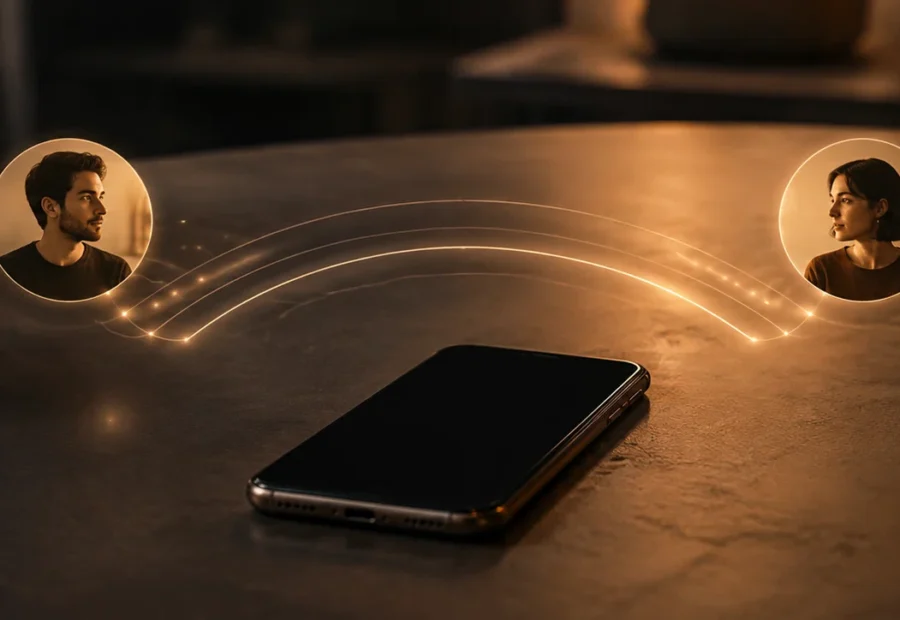

There is a big difference between having a feeling and knowing what to do with it. private mutual crush app works best when the first move is clear enough to understand and light enough that either answer can be handled normally.
The details around known person dating and mutual interest are where that balance usually lives: privacy where it helps, directness where it matters, and no pressure disguised as persistence.
Table of Contents
What a private mutual crush app actually is

A the process is not a dating app in the usual sense. There is no endless feed, no strangers, no random discovery loop pushing you toward people you have never met. It is closer to a discreet mutual-intent messenger.
Here’s the clean definition:
- You send a private crush to someone you know using their phone number or email.
- Your identity stays masked unless they also express interest.
- If the crush is mutual, both identities are revealed and a conversation can start.
That mutual-only reveal is the whole point. It protects your social life while still giving the connection a chance.
This is why apps like wadaCrush feel different right away. They are built around emotional safety first: private by default, identities masked until you pair, and no public profiles unless someone opts into future visibility features.
Why a this approach guide matters now
A lot of crushes do not fail because there was no chemistry. They fail because the setup feels risky. Maybe you share friends. Maybe you work together. Maybe you are worried about getting friend-zoned, bro-zoned, screenshotted, or becoming group chat content for no reason.
Traditional dating apps do not solve that problem because they are designed for discovery, not discretion. They help you meet people. They do not help you safely test the waters with someone already in your real life.
That is why a this approach guide needs to be honest about the trade-off. This setup is amazing for known-person that option discovery. It is not an alternative to stranger dating apps, and it is not built for one-sided anonymous pursuit. If your goal is random discovery, this is the wrong tool. If your goal is less cringe around a real-life crush, there is no better setup.
The 5 rules in this situation guide
1. Use it for known people only
This works best when the person actually knows who you are once the match happens. Friend, classmate, coworker, mutual, gym crush you have spoken to – yes. Random person you saw once and never interacted with – probably not.
The emotional safety comes from context. The app removes the fear of saying it first. It does not remove the need for basic social sense.
2. Choose privacy-first features over hype features
Not every crush app is equally careful. A good this situation guide should tell you what matters most: no public profile feed, no searchable identity by default, and mutual-only reveals.
Bonus points if the app can notify someone by SMS or email even when they are not already signed up. That matters because real life is messy. People use different emails, different numbers, work aliases, personal aliases. A thoughtful app lets users verify multiple identifiers so messages do not vanish into the void.
3. Be honest about the context
A private app reduces awkwardness. It does not erase power dynamics.
If the crush involves a direct manager, a professor grading you, or someone in a clearly unequal situation, pause. Privacy helps with embarrassment, not ethics. Some crushes are better left alone until the situation changes.
4. Do not spam your entire contact list
This should be obvious, but here we are. A the idea is not a personality quiz where you tap half your city and wait for upgrades.
Use it with intention. One or two people you genuinely like is normal. Turning it into a fishing net kills the point and raises the risk of social weirdness if multiple circles overlap.
5. Have a plan for after the match
The reveal is not the finish line. It is the start of a normal human conversation.
Keep it simple. You do not need to act like you just won a reality show. Something like, “Okay, glad that was mutual. Want to grab coffee this week?” works better than a paragraph about fate.
Why this beats a normal dating app for real-life crushes
A standard dating app asks, “Who is out there?” A this kind of connection asks, “Is this person already in my life into me too?” Those are completely different jobs.
There are trade-offs. A private setup has a smaller pool by design because there are no randoms. You cannot browse your way into chemistry. But that limitation is also the advantage. It filters for real-life relevance, not infinite distraction.
What to watch out for before you send a crush
Social circle overlap
If you both share the same close group, discretion matters even more. Look for a platform that keeps things fully private until there is this context. That way, a no stays invisible and everyone gets to keep their dignity.
Workplace dynamics
Coworker crushes are not all the same. A peer in another department is different from your direct report. If there is any chance of pressure, conflict, or policy issues, be careful.
Mixed signals
Sometimes the app is useful because the in-person vibe is impossible to read. Sometimes the mixed signals are actually a sign to slow down. If someone is consistently unavailable, not responsive, or only flirty when bored, a private mutual crush app can clarify things – but it cannot fix inconsistency.
A practical example
Let’s say you have a crush on someone from your extended friend group. In person, it is playful but unclear. You do not want to make it weird before the next birthday dinner.
A private mutual setup lets you express interest without forcing a public moment. If they feel the same, great – now you can talk like adults. If not, your identity stays hidden and the friend group survives untouched.
If it matches, keep the first message light:
If they say: “Lol okay, so it was you?” Reply: “Yep. Figured I’d vibe-check instead of making it awkward in public. Want to get coffee?”
That tone works because it acknowledges the moment without overcooking it.
Who this setup is best for
This private mutual crush app guide is really for four kinds of people. The first is the friend-crush person who has been stuck in maybe-energy for months. The second is the classmate or coworker crush person who wants clarity without public risk. The third is anyone exhausted by stranger-based apps and ready for more intentional connections. The fourth is the privacy-first person who wants no searchable profile, no random browsing, and no pressure to perform online.
Used well, this setup is weirdly simple. You send a quiet signal. They only see enough to respond privately. If it is mutual, identities unlock. If not, no scene, no humiliation, no social fallout.
That is also why wadaCrush stands out in this category. It keeps the experience discreet, allows crushes to be sent by phone number or email, works even if the other person is not already on the app, and only reveals identities after the next step. For known-person crushes, that design just makes more sense than the usual swipe chaos.
FAQ
Is a the idea anonymous?
At first, yes – or it should be. The sender stays hidden unless the interest is mutual.
Can you send a crush to someone who is not on the app yet?
On some platforms, yes. That is one of the most useful features because real-life crushes do not always happen between two current users.
Is this better than asking someone out directly?
It depends. If the context is low-risk and you are comfortable being direct, asking in person can be great. If there is social overlap, uncertainty, or real fear of awkwardness, a private mutual setup is often smarter.
Is this for strangers?
No. The model works best for people who already know each other in real life.
What happens if the feeling is not mutual?
Ideally, nothing public at all. That is the point of a mutual-only reveal system.
The best move is not always the boldest one. Sometimes it is the smartest one – private, clear, and respectful of everyone involved. If a crush has real-life stakes, choose the path that gives the connection a chance without turning your social life into collateral damage.
this kind of connection: what matters in real life
A good decision about private mutual crush app starts with context. How well do you know the person? Will you keep seeing each other if the answer is no? Is there any power imbalance, professional rule, or existing relationship that changes what a respectful move looks like? Those questions are more useful than trying to decode one emoji or one unusually warm conversation.
The healthiest version of private mutual crush app leaves space for a genuine yes and an uncomplicated no. Privacy can reduce unnecessary exposure, but it should never be used to keep pushing after the other person has shown disinterest.
known person dating: the practical standard
known person dating should make the situation easier to understand, not harder. If a method depends on guessing, repeated nudges, or making the other person investigate who is behind a message, it is creating more tension than clarity.
A better rule is simple: use known person dating to create one clear opening, then watch what the other person chooses to do with it. Reciprocity matters more than clever tactics. When interest comes back voluntarily, you have useful information. When it does not, give the situation room.
mutual interest: how to keep the pressure low
that pattern works best when the other person never feels cornered into an immediate answer. That can mean choosing a private format, asking a specific but easy-to-decline question, or simply making one invitation and letting them decide whether to continue.
The point of mutual interest is not to eliminate vulnerability. Dating still involves uncertainty. The point is to remove avoidable social pressure so the answer reflects interest rather than discomfort.
Separate privacy from secrecy
Privacy protects a moment that does not need an audience. Secrecy is different: it can become a way to avoid accountability. With private mutual crush app, the useful middle ground is discreet at first and normal once interest is mutual.
If two people are interested, the next step should eventually become an ordinary conversation. If the feeling is not mutual, the private approach should make it easier to move on without exposing anyone or turning the situation into gossip.
A realistic way to read the response
Imagine you make one low-pressure move connected to private mutual crush app. A positive response usually creates forward motion: they answer the actual question, suggest a time, continue the conversation, or make their own effort. A vague response is different. It may simply mean uncertainty, busyness, or lack of interest.
You do not need to interrogate the ambiguity. Give it space. If the other person wants to keep the connection moving, they can participate. That approach protects both people and keeps private mutual crush app from turning into a one-sided project.
Three mistakes worth avoiding
1. Treating one signal like a guarantee
Warmth, eye contact, fast replies, or a good conversation can be encouraging, but none of them creates an obligation. Use them as context, not proof.
2. Repeating the move until you get the answer you want
One respectful attempt is information. Repeated attempts after a weak or negative response create pressure. known person dating should reduce that pressure, not disguise it.
3. Making privacy the entire relationship
If mutual interest becomes clear, move toward accountable communication. mutual interest is a bridge to clarity, not a permanent substitute for talking.
How to decide whether this approach fits you
private mutual crush app is most useful when you already have a real person and a real social context in mind. It is less useful when what you actually want is broad discovery, constant novelty, or a way to contact someone who has never invited interaction.
Ask yourself what problem you are solving. If the problem is “I like someone I know and I want a lower-pressure way to find out whether the feeling might be mutual,” then private mutual crush app can be a sensible framework. If the problem is simply meeting more strangers, a different tool may fit better.
What to do after the answer
If the answer is positive, keep the next step ordinary. Suggest coffee, a walk, or another simple plan that lets the two of you talk without suddenly acting as though one signal settled the entire relationship.
If the answer is negative or nothing develops, the cleanest response is to accept it. No detective work, no public postmortem, and no attempt to turn private mutual crush app into a second chance mechanism. Handling the answer well is part of making the first move well.
Privacy questions worth asking before you trust a tool
For any product connected to private mutual crush app, look for plain-language answers about what other users can see, when identity is revealed, how contact information is handled, and how someone can block or report unwanted activity. A privacy label is not useful if the interaction itself still exposes more than you expected.
The Federal Trade Commission publishes broader consumer guidance on online privacy and security. That guidance is not a review of any one dating product, but it is a useful reminder to treat personal information as something worth protecting.
that first move: the bottom line
The strongest version of private mutual crush app is not the one that guarantees a yes. It is the one that gives you a clear, respectful way to learn something real without creating unnecessary pressure for either person.
Use known person dating to keep the first move intentional, use mutual interest to protect the other person’s freedom to choose, and let reciprocity determine what happens next. That standard works whether the answer becomes a date, a friendship, or simply useful clarity.
Keep reading
- Example of Private Crush Confession That Works
- Can a Crush Stay Private? Yes – Here’s How
- Best Mutual Crush App Comparison for Real Life
One more useful test for private mutual crush app is whether the approach still feels respectful after the excitement wears off. If you would be comfortable with the same behavior being described plainly to a friend, that is a good sign. If the plan depends on hiding persistence, creating urgency, or making the other person feel responsible for your emotions, simplify it.
It also helps to separate attraction from compatibility. known person dating can tell you something about interest, but it cannot answer every question about timing, values, or whether two people actually work well together. Treat the first signal as the beginning of information, not the end of the decision.
When you are unsure, choose the option with less social pressure. mutual interest should leave the other person more freedom, not less. A clean invitation, a private signal, or a little extra time can all be better than forcing a high-stakes conversation before either person is ready.
Check the default privacy settings
What matters here is the pattern you can actually observe. When evaluating private mutual crush app, look past the marketing screen and check the actual defaults. known person dating should reduce unnecessary exposure, while mutual interest should make it clear what happens before, during, and after a match.
That keeps the advice useful in a friend group, at work, on campus, or anywhere you are likely to see the same person again.
Follow the non-match experience
A useful way to think about this is to make the next decision smaller. A useful way to judge private mutual crush app is to follow the whole user journey. Ask what another person can see, what gets stored, and how known person dating and mutual interest affect a non-match as well as a successful one.
When in doubt, prefer the option that is easy to reverse and easy for the other person to decline.
Separate discovery from known-person matching
What matters here is the pattern you can actually observe. For private mutual crush app, privacy and product fit belong in the same conversation. Strong known person dating gives users control; sensible mutual interest keeps that control understandable in real situations.
If the response is clear, respect it. If it is mixed, give the situation enough space for the other person to contribute without being chased.
Read permissions before tapping Allow
This is where real-life context matters more than a perfect script. When evaluating private mutual crush app, look past the marketing screen and check the actual defaults. known person dating should reduce unnecessary exposure, while mutual interest should make it clear what happens before, during, and after a match.
The point is not to eliminate uncertainty; it is to remove avoidable confusion and make the next step proportionate to what you actually know.