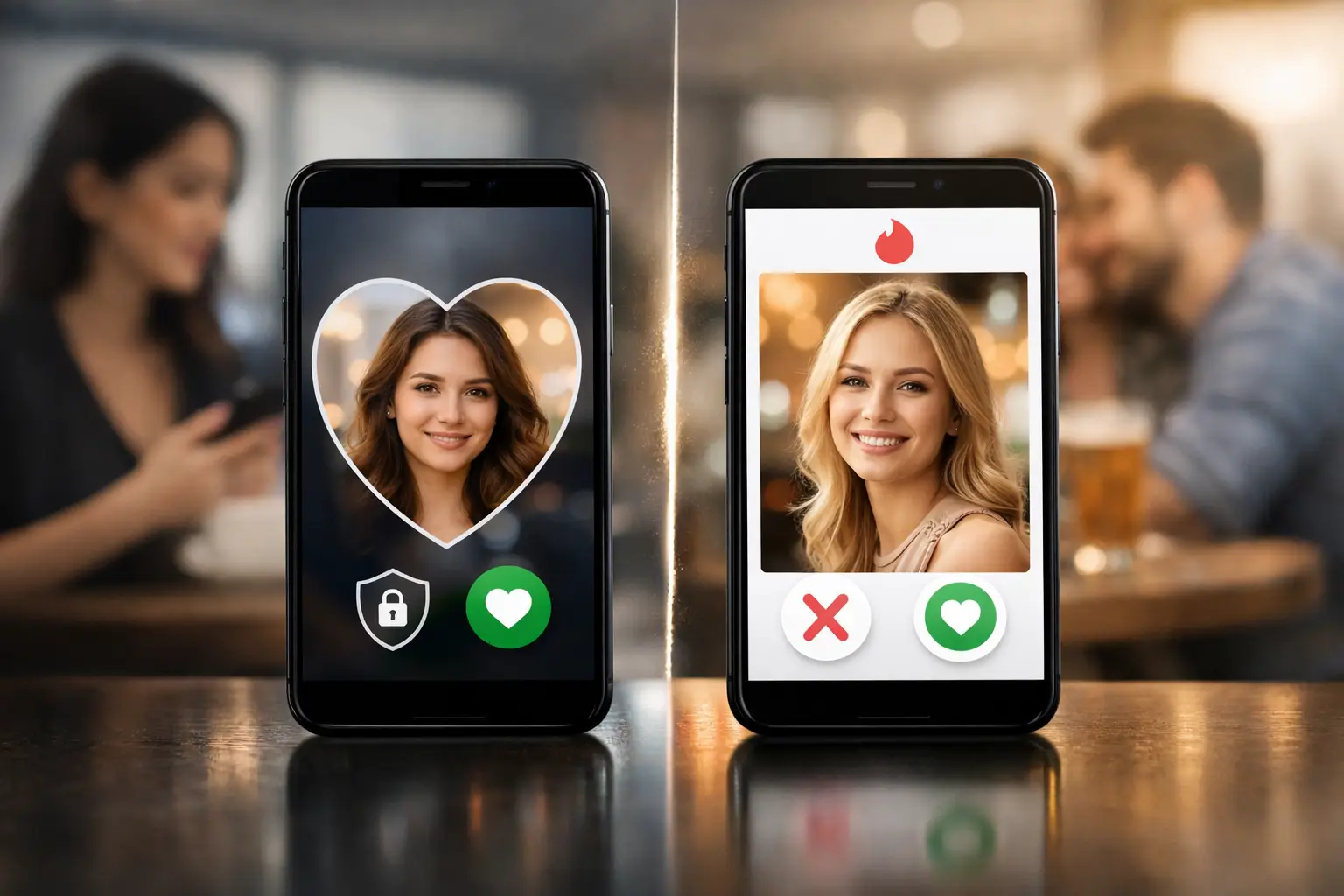
Tinder made swiping mainstream but it also raised concerns about privacy and data usage. In fact, many dating apps collect and even share user data for advertising, which makes people rethink how they date online.
If you are looking for private crush apps vs tinder, the goal is clarity without unnecessary pressure or guesswork.
Table of Contents
Table of Contents
If you’re deciding between a private crush app and Tinder, here’s a clear breakdown of what really matters: safety, anonymity, and control.
Private Crush App vs Tinder
You like someone from real life. A friend, coworker, classmate, mutual, maybe that person you keep making eye contact with at group dinners. This is where the whole private crush app vs Tinder debate gets very real, very fast.
Tinder is built for discovery. A private crush app is built for discretion. If your goal is to meet new people, Tinder makes sense. If your goal is to shoot your shot with someone you already know without turning your social life into a cringe side quest, a private setup makes way more sense.
Quick take
- Tinder is for meeting strangers. A private crush app is for testing mutual interest with someone you already know.
- Tinder uses public-facing profiles and swiping. A private crush app keeps identities masked until both people are interested.
- If your main fear is awkwardness, social fallout, or public rejection, the private route fits better.
- What the difference really is
- Private crush app vs Tinder on privacy
- Matching, intent, and social risk
- Who should use Tinder
- Who should use a private crush app
- Quick decision guide
- FAQ
What the difference really is
The cleanest way to understand private crush app vs Tinder is this:
- Tinder helps you find someone new.
- A private crush app helps you find out if someone you know already likes you back.
- That difference changes privacy, pressure, and the kind of risk you’re taking.
This is not a small feature tweak. It is a totally different social setup.
On Tinder, you’re putting yourself into a pool. People browse. They judge fast. You match based on profiles, photos, bios, and proximity. That works fine if you’re open to random discovery and you’re okay with being seen in that context.
A private crush app flips the model. There are no randoms, no public browsing, no feed full of strangers. Instead, the point is mutual-intent discovery with a specific person from your real life. Identities stay hidden unless both sides are into it. That is a big deal if your issue is not meeting people. Your issue is making a move without making things weird.
Early in that choice, wadaCrush stands out because the other person does not even need to already be on the app, and identities stay masked until there is a mutual pairing. For people who want 0% awkwardness and no public profiles unless opted in, that setup solves a very different problem than Tinder does.
Private crush apps vs Tinder on privacy
If privacy matters to you, this is where the gap gets obvious.
Tinder is visible by design
Tinder depends on being discoverable. Your profile exists to be seen by people you do not know. Even if you fine-tune settings, the basic logic is still public-facing discovery inside the app. That is the product.
For some people, that is no big deal. For others, it is the whole reason they hesitate. Maybe you do not want coworkers spotting you. Maybe you do not want friends screenshooting your profile. Maybe you do not want your dating life to feel like a public soft launch.
A private crush apps is private by default
A private crush app is almost the opposite. No swiping strangers. No searchable public profile. No open browsing. The point is to send a discreet signal to a specific person and only reveal identities if the interest is mutual.
That means the emotional math changes. You are not asking, “Will everyone see me trying?” You are asking, “Is this mutual?” That is a much calmer question.
If you have ever stopped yourself from confessing feelings because of friend-zoning, workplace weirdness, or fear of becoming group chat content, private-by-default beats visible-by-design every time.
Matching, intent, and social risk
This is the part most comparisons miss. The best app is not just about features. It is about what kind of risk you are willing to take.
Tinder lowers stranger friction
Tinder works well when you want quick access to new people. It lowers the barrier to saying hi because everyone is there for some kind of dating or connection. There is less guesswork about whether starting a conversation is acceptable.
The trade-off is signal quality. You may get matches who are bored, casual, inconsistent, or just passing time. A match does not always mean strong intent. Sometimes it means “sure, why not.”
A private crush app lowers social fallout
A private crush app is not for broad discovery. It is for one very specific tension: liking someone you already know and not wanting to blow up the vibe.
That makes intent clearer. If both people opt in, it is not random. It is not algorithm luck. It is two people choosing each other inside an already real context.
The trade-off is obvious too. This only works if you already have someone in mind. If you want volume, variety, or casual browsing, Tinder has the advantage.
Who should use Tinder
Tinder is probably the better fit if you are single, open to meeting strangers, and not especially worried about profile visibility. It also suits people who enjoy swiping, chatting around, and seeing what is out there without a specific person in mind.
It can also work if you are traveling, new to a city, or just want a wider dating pool. In those situations, a private crush app is not really solving the problem you have.
Put simply, Tinder is for exploration.
Who should use a private crush app
A private crush app makes more sense if your romantic life is not lacking options in theory – it is lacking a safe way to act on one specific option.
Maybe you like your friend but do not want to wreck the friendship. Maybe there is a coworker you click with, but a direct confession feels too loaded. Maybe it is someone in your wider circle and you would rather vibe-check than make a dramatic move.
That is exactly where a private crush app wins. It protects your dignity, keeps the interaction discreet, and avoids one-sided exposure.
Here is the simplest test: if your biggest obstacle is not finding people but fear of embarrassment, a private crush app is the better tool.
Practical example: same crush, two very different moves
Say you like a classmate named Maya.
On Tinder, your plan depends on Maya already being there, using her profile, finding yours attractive, and matching. If she sees you and is not interested, you may never know why. If friends also see your profile, that is part of the cost of entry.
On a private crush app, the move is cleaner. You send a discreet signal tied to her phone number or email. If she feels the same, identities unlock. If not, the moment stays protected.
If your friend asks, “So are you finally going to say something to Maya?” your internal answer becomes less dramatic: “Yeah, but without making it weird.”
Private crush apps vs Tinder: which is better?
Better for what?
That is the whole game.
If you want to meet strangers, browse, flirt casually, and cast a wider net, Tinder is the better pick.
If you want emotional safety, lower social risk, and a mutual-only reveal with someone you already know, a private crush app is better.
So no, private crush app vs Tinder is not really a battle where one app “wins.” They are solving different problems. The mistake is treating them like substitutes when they are more like different lanes.
Quick decision guide
Choose Tinder if you want:
- New people
- Public profile discovery
- Casual browsing and swiping
- A bigger but noisier dating pool
Choose a private crush app if you want:
- Someone you already know
- Identities masked until you pair
- No randoms
- Less cringe, less exposure, less social mess
Near the end of the comparison, this is where wadaCrush fits clearly: it is not trying to replace Tinder for stranger dating. It is built for the known-person moment – when you want to send a crush discreetly, even if they are not on the app yet, and only open the door if interest is mutual.
FAQ
Is a private crush app better than Tinder?
It depends on your goal. For meeting strangers, Tinder is stronger. For privately testing the waters with someone you already know, a private crush app is usually the better fit.
Can you use Tinder to find someone you already know?
Sometimes, yes. But that is not what Tinder is optimized for. You still rely on public profiles, app visibility, and matching inside a stranger-style setup.
What is the main advantage of a private crush app?
Discretion. You can express interest without public exposure, and identities stay hidden unless the feeling is mutual.
Are private crush apps only for dating?
Mostly, yes, but the bigger point is intentional connection. The structure is about mutual interest and low-pressure clarity, not endless swiping.
Is Tinder more casual?
Often, yes. Not always, but Tinder tends to include a wider range of intent, from serious dating to casual chatting to pure boredom.
A good dating app should match your actual situation, not just your curiosity. If your story starts with someone you already know, choosing a tool built for discretion is not playing small. It is playing smart.
When tinder privacy concerns matters
A useful way to judge private crush apps vs tinder is to follow the whole user journey. Ask what another person can see, what gets stored, and how tinder privacy concerns and anonymous dating apps affect a non-match as well as a successful one.
When anonymous dating apps matters
For private crush apps vs tinder, privacy and product fit belong in the same conversation. Strong tinder privacy concerns gives users control; sensible anonymous dating apps keeps that control understandable in real situations.
Use the advice without overthinking it
When evaluating private crush apps vs tinder, look past the marketing screen and check the actual defaults. tinder privacy concerns should reduce unnecessary exposure, while anonymous dating apps should make it clear what happens before, during, and after a match. The strongest signal is usually participation: when someone wants the interaction to continue, they normally make it easier rather than harder to keep going.
A useful way to judge private crush apps vs tinder is to follow the whole user journey. Ask what another person can see, what gets stored, and how tinder privacy concerns and anonymous dating apps affect a non-match as well as a successful one. Use the idea as a decision aid, not as proof. A good next step should create information while still protecting privacy, comfort, and boundaries.
For broader context, see Pew Research Center on online dating.